In 2016, during my second Camino de Santiago (or, as I call it, Santiago II), at dinner with a small group of pilgrims, someone told me the story of a Hungarian truck driver. He walked his first Camino, the entire French Way (almost eight hundred kilometres), at fifty-seven. His second at sixty-one. Then, once retired, he walked the French Way twelve times in a single year, one Camino per month, to honour each of the apostles. His year, in practice, was rest-Camino-rest-Camino, rest-Camino-rest-Camino, and so on. I was impressed, but I thought he was a little crazy. Back then, though, I was already on my second.
Probably, if you follow this blog, you already know the story. But if you don’t: I walked the first one for a dream, and the second one to write a blog (you can find it here), since on the first I had kept communications close to zero. In both, though, I had not made it to Muxía and Finisterre. The third was a shorter route, from Vigo through Santiago, and this time, yes, Muxía and Finisterre. The fourth was with my then-girlfriend, from Oporto. You know, happiness is better when shared. The fifth was because we had split up, and I knew that, walking to Santiago, I could find peace.
Long story short, I ended up walking the Camino twelve times. When I closed the twelfth, a few days ago, I thought again about the Hungarian truck driver. I have not walked the entire French Way twelve times in twelve months. I have walked many different routes over these years, of many different lengths, all of them ending in Santiago, and most of them reaching Finisterre. But evidently something ties me to that place. There is a bit of him in me.
So why, why, why do I keep ending up there? The answer is very often religious. I have been to plenty of sacred places, but there is nothing like going through them walking. At least for me, it gives them a different vibe. So yeah, religion first: up to Santiago, it is for God. I offer what happens along the way, and most times things do happen, believe me. But when I have the opportunity to continue to Fisterra, as the Galicians call it, that last part, usually three or four days, is for Marco. It is my redemption.
That said, most people do it for tourism, some for spiritual reasons, some to find themselves. There is no right or wrong, and after a few Caminos you stop judging. Do you want to start from your own home, in poverty and barefoot? Good. Do you want to walk one hundred with booked rooms, sending the backpack ahead from place to place? Good.
Still, you can guess that behind something that smells of craziness, like twelve Caminos in twelve years, there have to be other reasons too. Fair enough. Here are the main ones.
First, the body. Mine has settled into a mode of its own: pushing for eleven months, then unplugging for two or three weeks in August to dive back into my natural side. Nature, instinct, living without an agenda. I love it. I love feeling like a caveman. I love using my eyesight to look at arrows from far away. I love not wearing a suit. And I also love getting reacquainted with discomfort. The nights in the albergues, with the hospitaleros and the pilgrims. The microfibre towels, because terry cloth weighs too much. Living with the bare minimum: in the end it is just a backpack, and not much else. And yes, behind the discomfort there is the sacrifice part. Why chill by the sea when you can suffer and grow? I guess my Christian background has a lot to do with it.
The other ones? Many. Meeting new people. Sharing something that does you good. Singing and shouting in the woods where no one can hear you. Doing something to be proud of. Because, if I think back, Santiago I was the first thing I was ever truly proud of. I was not that proud when I graduated from university, and I was not that proud when I became a lawyer. That was the first thing I was truly proud of. The kind of thing that makes me think: “If I die now, it will still have been a life that did something good.” And for a perennially unsatisfied person like me, that ain’t bad.
What else? Well, the Camino gives you direction. It tells you where you need to go. It does not solve your problems, despite what many pilgrims believe, but at least, while you walk, it tells you: leave that person, leave that job, make that investment, change city, live that experience. Then, as always, it is up to you to go home and do the hard things. Unlike most, I love this part. I love that it ends.
Some people, though, never want to face that issue, or forgive that person, or make peace with themselves. Luckily for them, they tend to go back, and back, until they find the strength.
Have I finished with the reasons? Not yet. Because there is one I discovered along the road, and it has quietly become the leitmotiv of this blog: your mind is, most of the time, overestimated. We listen to it far too much, and there are things that the body, the spirit, and the soul know much better than the mind does. They are also far more reliable. So I do it to Feel. With the capital F.
And if you want to start Feeling, know this: you do not learn it in thirty seconds. It is a skill that takes a lifetime. But if you work on it, you’ll have a mind that gets lighter and lighter, emptier and emptier, and feels more and more, including the things that are not working (and there are many, in me and in this world. Good news: once you see them, you can do a lot).
So, if I have to find a why for these twelve Caminos, it goes like this.
At the beginning, it was to ask for something.
Then, to live in perennial gratefulness.
Then, to shut the mind up and learn how to Feel.
All of this, while Destiny plays with me like a puppet master. And I love being on autopilot, where God leads and I follow.
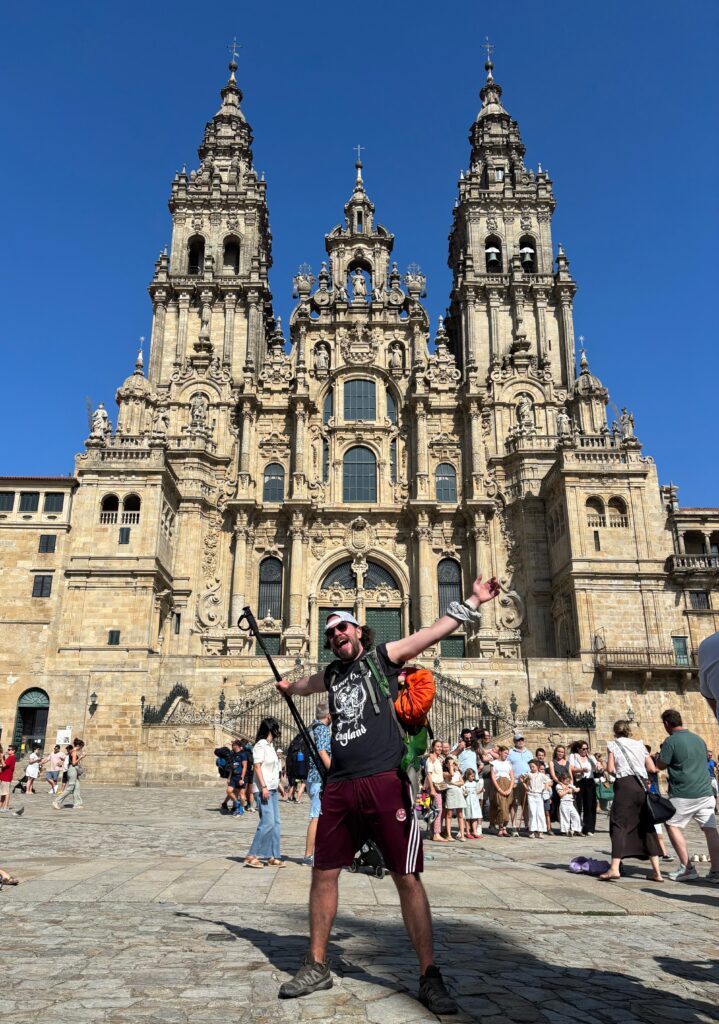
I guess that twelve is a good number.