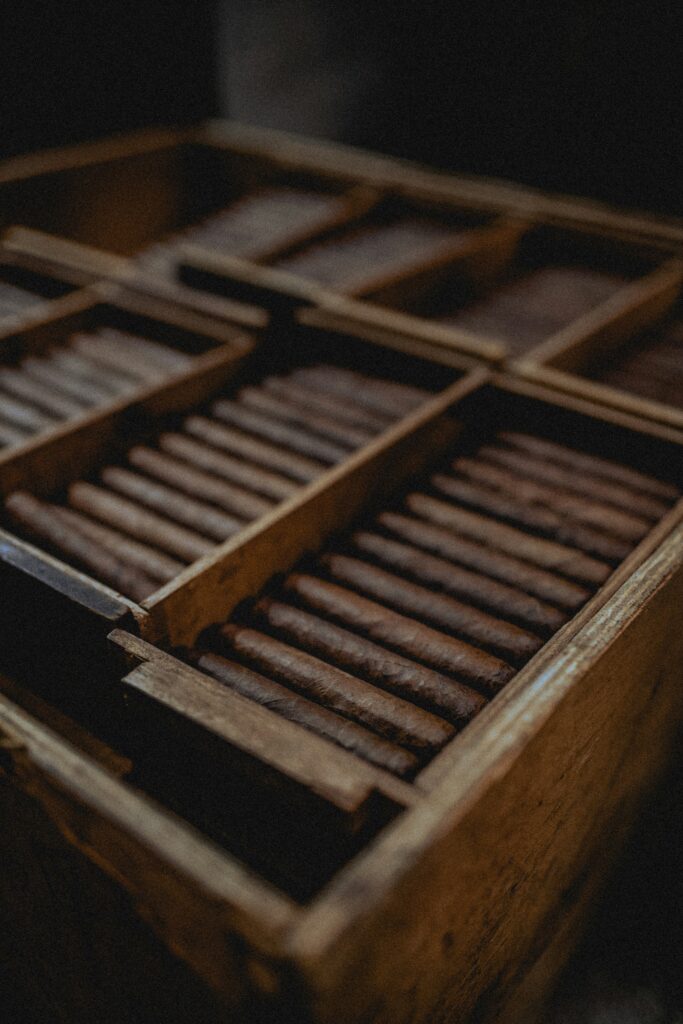
I keep a list of people I would have loved to meet. Most of them, Gandalf included, never existed. Zino Davidoff did. I just got here late.
Picture this. A Jewish family flees the pogroms of the Russian Empire and arrives in Geneva in 1911 with a five-year-old boy. The father, Henri, knows one trade, tobacco, so he opens a small shop. The back room becomes a meeting point for Russian exiles, who blend leaves and talk revolution. House legend says one of the regulars was a certain Vladimir Ilyich Ulyanov, who rarely paid his tab and later took the name Lenin. Some versions add Churchill, although even the official history admits he never appears among the customers.
In 1924 the father sent the boy, now eighteen, across the ocean to learn tobacco from the leaf up. Argentina first, then Brazil, then Cuba, where Zino spent years on the plantations and called what he found there “a discovery, a wonder.” At eighteen I was taping band posters to my wall and translating Latin. Everyone has his own apprenticeship.
He came back to Geneva around 1930 with a problem in his head: cigars are alive, and Geneva is not Havana. So he convinced his father to turn the basement into a climate-controlled cellar, considered the first of its kind in Europe. The desktop humidor, the box every smoker now takes for granted, is credited to him. Selling cigars was the easy part. Keeping them alive an ocean away from home was the real job, and he solved it.
When war broke out in 1939, the French state tobacco monopoly was sitting on some two million Havanas it could no longer sell. Zino bought the lot. For the rest of the war, if you wanted a proper cigar in Europe, the road ended in Geneva.
Cuba noticed. In 1946 came the Château series, Havanas dressed in the names of Bordeaux estates. In 1969 came something close to unthinkable: Cuba created a brand carrying the name of a living Swiss merchant, rolled at El Laguito, the same factory that makes Cohiba. Same hands, different blend.
Weigh that for a second. In 1924 a teenager crossed the ocean to learn tobacco from the Cubans. Half a lifetime later the Cubans crossed it back to ask that same man, a Swiss Jew who had arrived as a refugee child, what their own cigars should taste like. They had the soil, the seed, the sun, and generations of hands that knew the leaf. He had a shop and an obsession with getting it right. They called him.
In 1970 Zino sold the business to the Oettinger group of Basel and stayed on as the face, and the palate, of the house. Then came the eighties. Cuba pushed volume, and quality slipped. Zino complained that some deliveries arrived “as hard as this table and quite unsmokable.” He said it on French television too, which was not how things were done in that business. And when words changed nothing, he set fire to around 130,000 cigars bearing his own name, in a Basel incineration plant, with customs officials watching. Sources still argue about the exact year, somewhere between 1987 and 1989. Nobody argues about the number. By 1991 the marriage with Cuba was over, and Davidoff moved to the Dominican Republic.
Now, a personal note. I love Cuban cigars. And anyone who smokes Habanos knows how it goes: one can be sublime, while the next may refuse to draw or burn unevenly. Outside a couple of renowned and expensive brands, the risk is part of the deal. With a Davidoff, I have never once seen it happen. No wrapper that split, no crooked burn, not even an ember that fell apart before its time. Nothing. And there may be a reason for that: Hendrik Kelner, the master blender who rebuilt the brand in Santiago, once said the company seemed to reject more cigars than it accepted. Zino’s obsession for quality embedded the brand he created.
Before the millions, before the boutiques, the perfumes, and the eyewear that carry his name today, there was a man who saw longer than everyone else in the room.
He put it in writing in 1967, in a book that sold more than two hundred thousand copies: smoke less, but better.
He liked to say that a good cigar makes time stop.
He was right