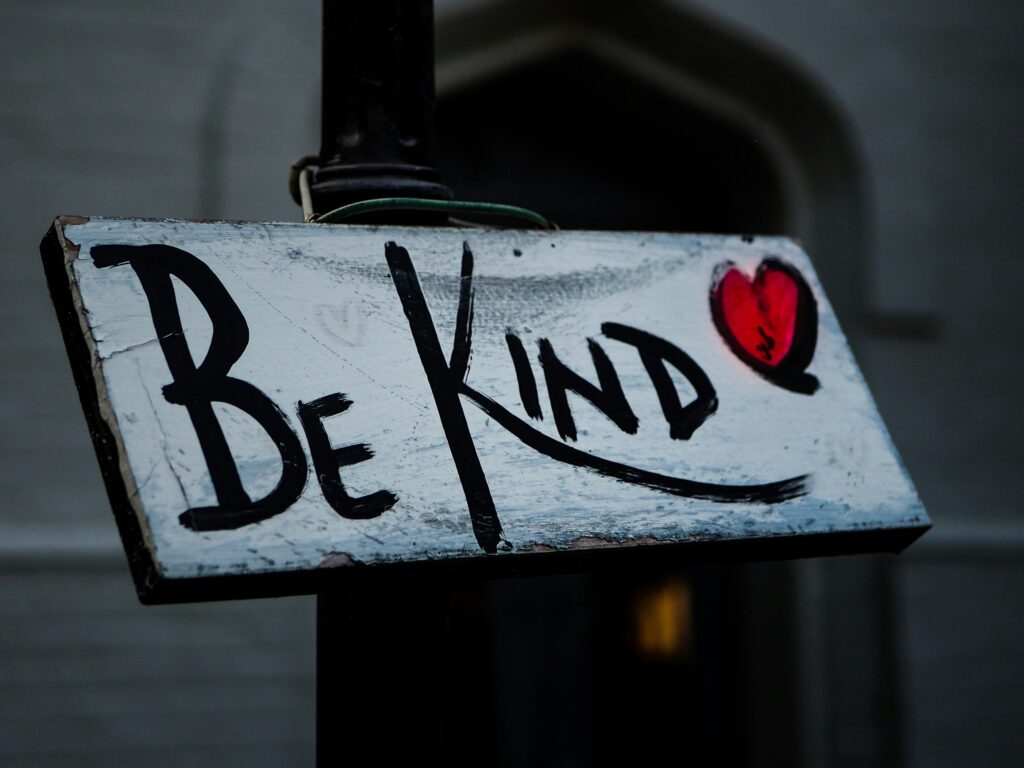
I try to be kind. That does not mean I always am. But I try to be.
I have come to think that kindness is an act of resistance. A small, stubborn refusal in a world that does not listen, does not care, and does not bother to put itself in anyone else’s shoes. It costs almost nothing and it changes almost everything, which is probably why we are so bad at it.
When I ask myself why I try, three answers come back.
The first is religious. Being Christian makes it almost easy. You are handed a set of rules, and you are asked to accept them without arguing. You just have to act. One of those rules, which you probably know, is to love your neighbour as you love yourself. Easier said than done, of course. But the instruction is there, plain, waiting.
The second is ethical. Everyone is fighting a battle. Everyone is carrying something heavy. And most of the time we have no idea what it is. The person who is short with you at the counter, the friend who goes quiet, the stranger who cuts in line. We see the gesture and miss the weight behind it. We judge the surface because the surface is all we are given. Kindness is what is left when you choose to assume the weight is there even when you cannot see it.
The third is harder to put into words. It has to do with the gifts destiny hands you when you act the right way. I like to tell stories, and this is one I have been telling for years. Historians, unfortunately, are fairly sure it never happened. But I keep it anyway. I believe in it the way you believe in a song: not because it is true, but because of what it does to you.
It goes like this.
A boy was drowning in a pond somewhere in the Scottish countryside. He had wandered too far, the water was deeper than he had thought, and the bank was too far to reach. No one was around to hear him except a farmer working in a nearby field. The farmer heard the cry, dropped what he was holding, ran, and pulled the boy out of the mud and the cold. He sent him home shaking but alive, and went back to his work, the way people do when they have done something enormous without realising it.
That boy belonged to a wealthy family. His father, grateful in the way that only fear turned to relief can make a man grateful, came to find the farmer. He wanted to pay him. The farmer refused; he had only done what anyone should do. But the rich man noticed the farmer’s own son standing in the doorway, and made a different offer. He would pay for the boy’s education. Not a small school. The finest one money could buy. A debt of one life, repaid by opening another.
The young boy was Winston Churchill. And the farmer’s son grew up to be Alexander Fleming. Fleming, years later, looking at a forgotten petri dish he should have thrown away, discovered penicillin. The drug that would go on to save more lives than any single act of medicine before it. Millions of them
So one of the great discoveries of the twentieth century would trace back, link by link, to a single act of kindness on an ordinary day. A farmer who ran toward a drowning child. A father who chose generosity over a cheque. A door held open instead of closed. And at the end of the chain, an entire century quietly in someone’s debt without ever knowing the names.
I know the story is probably false. The dates do not align, the records do not support it, and the people who study these things have dismissed it more than once. According to most historians, there was no drowning boy, no grateful lord, no education paid for out of gratitude. By every serious account, it is a story we tell ourselves.
And yet, it remains true in the only way I need it to be.
It reminds me that a small kindness can travel farther than we will ever know. That the person we help today may carry that help somewhere we will never see, through a chain of consequences none of us is allowed to follow to the end.
We never get to watch the whole arc. We only get to throw the stone, and trust the water to carry the ripple further than we will ever see.
To believe, despite all the evidence, that the world can still be kinder than it is.
And I would rather live as if it were.