In Italy, religion aside, two things are sacred: food and football. This year, for reasons every Italian knows, I can only write about one of them. The national team missed the World Cup for the third time in a row, and July is too soon for the campionato and the Champions League. So, food.
Let’s start with the paradox. I am a terrible cook.
Part of it is luck. I have spent most of my life surrounded by great women: mama, grandmas, aunts, girlfriends. They cooked the way other people breathe, and my job was to enjoy the food, sit at the table and judge. I took it very seriously. And yes, I have no problem admitting it: I have been spoiled rotten.
Part of it is a decision. I cannot be an expert in everything, and I aim to do well a huge amount of things: entrepreneurship, blogging, public speaking, guitar, qi gong, plus a lot of other stuff. Something had to go. So I decided not to cook and not to garden.
Of course I can survive in a kitchen, and cook decently a small amount of dishes. But my standards are way higher than you think. Because I know how to eat. I really know.
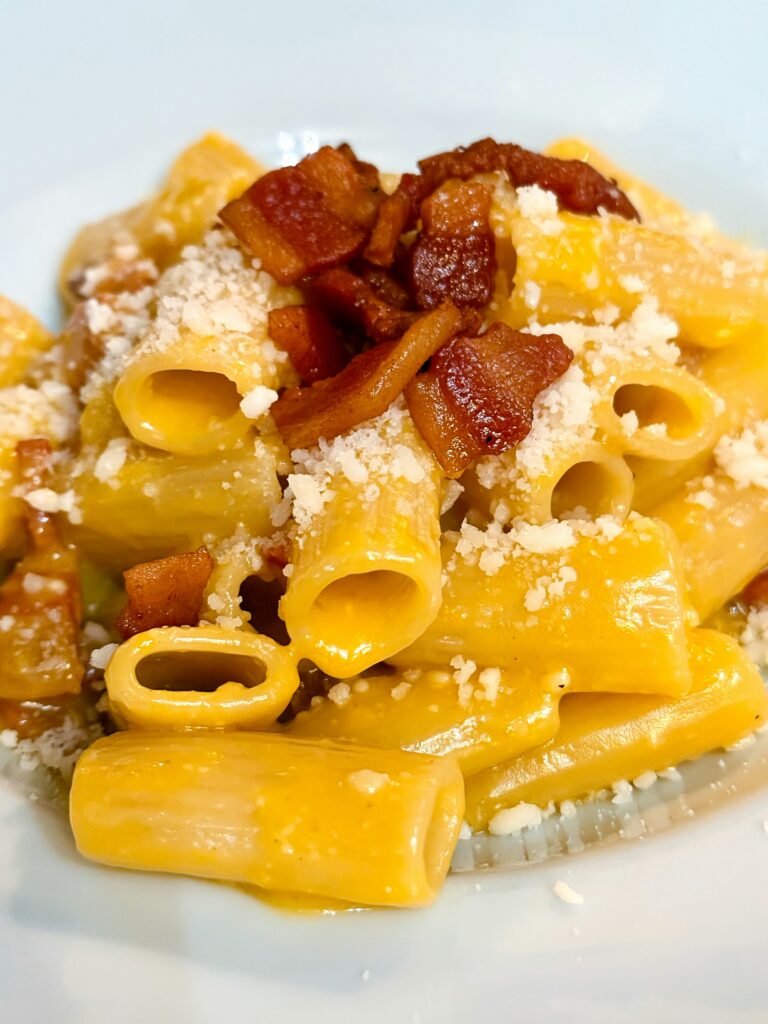
Take the carbonara, one of my favorite dishes.
Il guanciale deve criccare. I keep this in Italian because English has no verb for it: the guanciale has to crackle, to give that small dry crunch between your teeth. If it does not, you are eating something else.
A word for the uninitiated: guanciale is cured pork cheek aged with salt and pepper. Ham comes from the leg. Bacon comes from the belly, and it is usually smoked. Three cuts, three different worlds. In the pan, the fat of guanciale melts slowly and becomes the sauce itself. There is no substitute.
The pasta, obviously, needs to be made by hand.
On the eggs, there is a whole disquisition. The bare minimum is one egg per person plus one for the pan. Some cooks use two per person. And I know one place in Rome (Lo Scopettaro, if you want to know), that goes up to three. Three eggs per person. You do not forget a carbonara like that. In Italy, these numbers are debated with the seriousness other countries reserve for constitutional reform.
The pecorino, a sheep’s milk cheese (pecora means sheep in Italian), must be rigorously grated and rigorously aged. And here the tale turns sad, because people put parmigiano on it. Nothing against parmigiano, a monument of its own. But not here, not on a carbonara. Think about what this one detail says: that we have lost the ability to age things properly and give them all the time they need; that we have lost our taste; that we have stopped being connaisseurs. Choosing a pecorino takes effort. Grabbing whatever cheese is already in the fridge takes ten seconds. We are becoming ten-second people.
Every city has its own obsession. In Bologna every 25th of December there is the Christmas dinner, and every family guards its own liturgy. The tortellini must be rigorously in broth. And broth has its own commandments: capon, tongue, a pot that simmers for twenty-four hours. The tortellini are cooked in the broth, never in water. And when they are made, each one is rolled around the mignolo of the left hand, the little finger. Only that finger. Only that hand.
Ask why and you will not get an answer. You will get a look. I love that look.
The truth is that we are all obsessed, each with his own thing. One of my partners at Better Ipsum, for example, is obsessed with crescentine, the fried dough they serve in and around Bologna. He has a Tripadvisor account dedicated to crescentine, and to crescentine only. More than ninety places reviewed, review after review, on the same subject. I know crescentine well. He knows them better.
What does all this tell you? It tells you that the way you do anything is the way you do everything. Show me how a cook treats his guanciale, and I will tell you how he treats everything else.
Maybe these may be considered maniac traits of my character. But the way we fuss over precision, improvement, and perfection shows up in our work too, and that ain’t bad at all. You know, it may be wine, it may be cigars, it may be food: but knowing the difference between good, bad, and excellent has many advantages.
It teaches you patience. It trains your focus. And it makes ten-second people a little uncomfortable, which is always a good sign.
Il guanciale deve criccare.