It was 2015. The woman I was dating at the time was going through a difficult period with her family, and one evening I decided to write her a long email about kintsugi, the Japanese art of repairing broken pottery with gold. Not a WhatsApp message. Not a voice note. An actual email. Because sometimes writing still matters. Even in dating.
She thanked me for it. A few days later, when we met again, she said: “No one knows about it. You should share this”. Almost ten years have passed since that moment.
A few days ago, while going through my emails, I found that old message again. I smiled, paused for a second, and realised it was finally time to make peace with that request, sharing the concept with a wider audience.
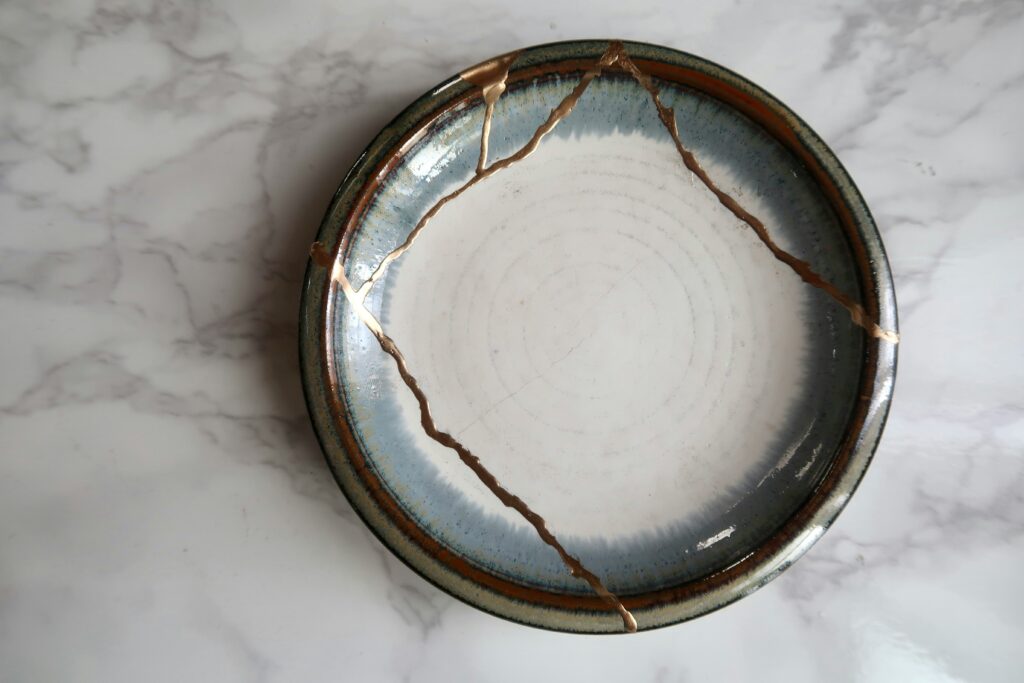
Kintsugi literally means “golden joinery.” It is an ancient Japanese technique developed in the fifteenth century. When a ceramic piece broke, artisans repaired it not by hiding the cracks but by filling them with lacquer mixed with powdered gold. The result was surprising. The object did not return to its original state. It became something else. Something more valuable and more beautiful precisely because it had been broken.
There is a quiet philosophy behind this. In kintsugi, the fracture is not a flaw. It is the place where beauty begins.
Back then, I remember noticing how different this was from the Western idea of repair. We tend to cover what is broken. To smooth it over. To pretend it never happened. “Good as new.” But kintsugi teaches the opposite. The goal is not perfection. It is integration. It is acknowledging the wound and transforming it into a visible, meaningful part of the story. And it is gold. Gold. Because something that has broken and healed carries a special kind of shine.
Over the years, I began seeing kintsugi everywhere.
In relationships that did not go as planned but left traces of tenderness.
In conversations that started in one place and ended somewhere unexpected.
In personal setbacks that, almost mysteriously, opened the right doors.
We all carry our cracks. The question is what we choose to do with them.
I like to think of kintsugi as a mindset. An invitation to look at our broken parts not as the end of something, but as the beginning of a new form we have not yet imagined. And ten years after that email, the concept feels more relevant than ever.
If you look closely, we are all a collection of fragments. Held together by the gold of what we have lived. Beautiful in ways we only understand with time.
We spend so much energy trying not to break.
The point is not to stay intact. It is to be open, to be vulnerable, and to learn how to shine through the cracks.
People notice breaks.
I see gold waiting to set
P.S. Her answer was far better than my message. I reread it too. But some things are not meant to be shared with a wider audience…