There are many places I love. And then there are a few I love the most, mostly because of their spiritual atmosphere. Assisi is certainly one of them.
This small Italian town, with fewer than 30,000 inhabitants, feels almost like a miracle. Six million visitors every year (ten million last year mainly because of the Jubilee and the canonization of Carlo Acutis), breathtaking landscapes, and an extraordinary concentration of saints. And yet, it preserves its intimacy, enough to make me feel sheltered and deeply at peace each time I return.
The food is wonderful, of course, and there is that warm central Italian spirit that makes welcoming strangers and laughing with them feel completely natural. For a while, I truly imagined building a life there. But there is no sea, which I love, and transportation makes things complicated. Business centers are far away, there are no major airports nearby, and trains are few and not always reliable. What protects its quiet beauty is also, paradoxically, what keeps it slightly apart from the rest of the world
Assisi is known for many remarkable figures, but above all for Saint Francis, the patron of Italy. This year is also particularly significant: it marks 800 years since Francis’ death, and celebrations are taking place across the country, especially in the city itself.
In Assisi, I have my favorite places. Some are well known: the Eremo delle Carceri, Santa Chiara, San Damiano, the Sanctuary of the Spoliation. Others are more hidden. Among them, the small garden inside Santa Maria degli Angeli.
Santa Maria degli Angeli, despite being associated with a small town, is one of the biggest churches worldwide. It is mainly famous for enclosing within it a much smaller church, the Porziuncola, which represents the beginning of Francis’ revolutionary path. Paradoxically, while most visitors focus on it (not surprisingly, the vibes of that little place are unique), my attention usually drowns to another site next to the cloister: a quiet garden.
As you can imagine, this is not just any garden. According to tradition, during a winter more than 800 years ago, Francis was struggling – deeply. Some say he was wrestling with temptations of the flesh. Others say he was questioning his path of poverty, sacrifice, and penance. In a moment of turmoil, he threw himself into a bramble to quiet his mind. You know, when your mind goes full-throttle, focusing on physical pain can sometimes feel like the best possible relief. Miraculously, the bramble turned into a bush of roses without thorns.
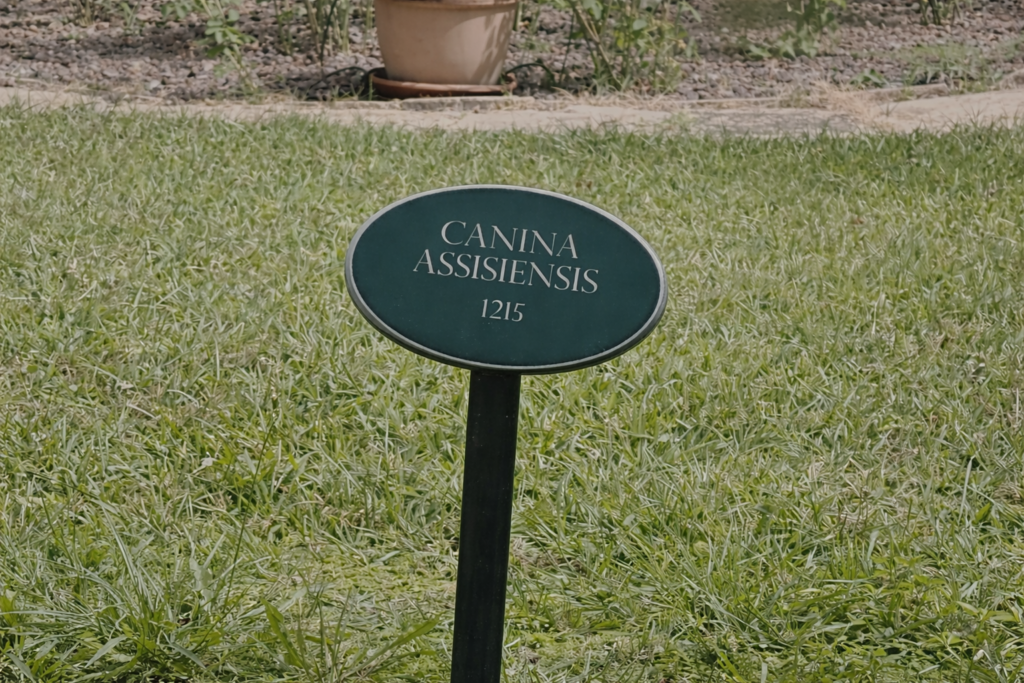
Today, eight centuries later, a rare variety still blooms in that quiet garden: a thornless rose known as “Rosa Canina Assisiensis”. According to tradition, it grows nowhere else. And roses without thorns are, in any age, an exception rather than the rule.
If you read this blog, you may know that I love dwelling in the realm of the unknown. I love not knowing, because certainty can be deceptive. It can inflate the ego and make us feel sure – perhaps too sure. The unknown leaves space for curiosity, and that is a blessing. When the mind cannot fully explain something, you are invited to trust your heart, your intuition, your sensations more than your reasoning. And often, those feelings carry a different kind of truth.
You can read this story in different ways. The Christian may see a miracle; the botanist, a rare variation of a well-known species; the child, simply the fragile beauty of a rose in bloom.
When I passed through that garden for the last time, the message felt unmistakable: why not hold all three perspectives at once?
Believe. Inquire. Wonder.
Seek meaning, question assumptions, and never lose the capacity for awe.