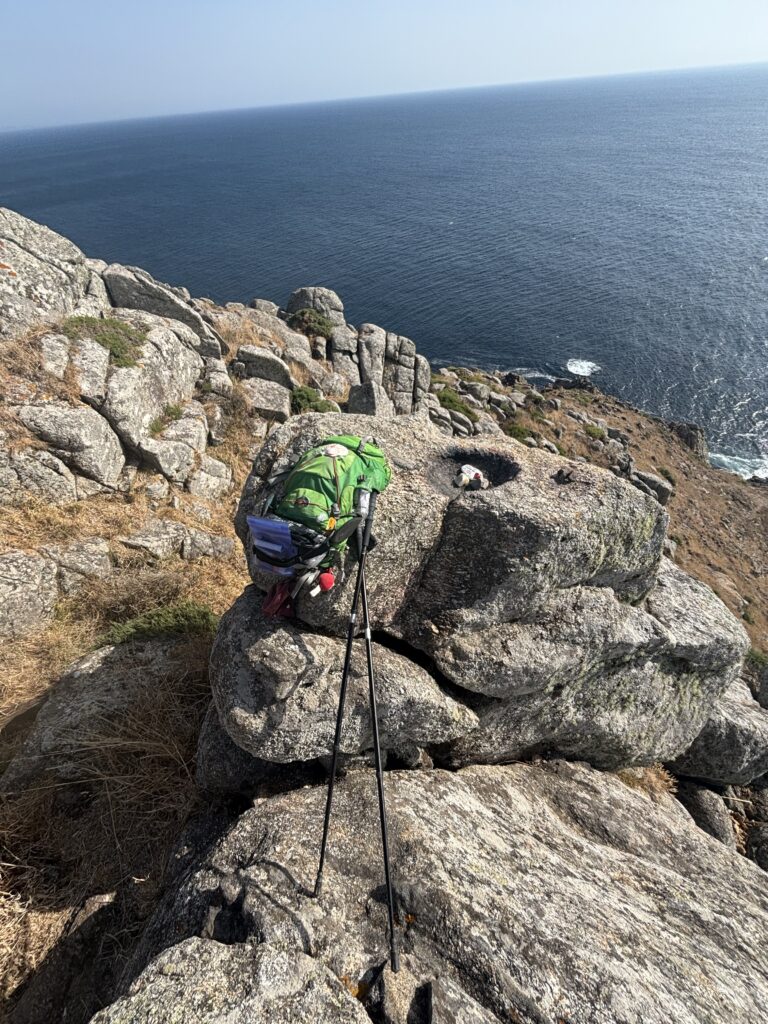
During my last Camino de Santiago (the eleventh) I found myself circling around a question I wasn’t quite ready to ask out loud.
Do I love suffering?
And believe me, it’s not an easy one to answer.
It’s not easy if you’re a Christian (and if you think Christianity has nothing to do with suffering, please go back and read the Gospels again).
It’s not easy if you’ve walked thousands of kilometers through tendinitis, food poisoning, and sleepless nights in hostels where the walls echo with the snoring of pilgrims from Milan to Pamplona.
It’s not easy if, for the past ten years, you’ve given up most, if not all, of your holidays for long, scorching Spanish summers, carrying everything you own on your back, choosing to do it again and again.
And it’s not easy if, looking back, the moments of suffering are the ones you hold dearest. The ones you’re strangely proud of.
So, do I love suffering?
No. I don’t.
But I do have a complicated relationship with goals. Especially the rare, personal ones I put at the top of my to-do list. Maybe one or two a year, the kind that really matters. Finishing the Camino. Running a marathon. Completing a Master’s degree. Writing a book. These aren’t casual intentions. They are deals I make with myself. And once they’re made, I keep them.
When I think at them, my mind races at a quote from Michael Jordan’s father when people accused his son of being a gambler:“Michael doesn’t have a problem with gambling. He has a problem with competition”
I’m not a gambler. And I don’t like competition (except with myself). But that change in perspective resonates deeply.
Because when one of those few, deep goals appears, I shift into a “whatever-it-takes” mindset. If suffering is part of the deal? So be it. Would I prefer to get there without pain? Of course. But it rarely works that way.
Sometimes, I enjoy the process. When I went skydiving or bungee jumping, I couldn’t wait to throw myself into the void (and I loved every second of it). But most of the time, I don’t.
I don’t like writing. I dread the blank page, the slow drip of thoughts turning (or failing to turn) into sentences.
I don’t like running. Believe me when I say that I’ve hated nearly every training session I’ve ever done.
I don’t like walking. And when it’s 38 degrees, uphill, and there are still 24 kilometres I complain loudly, so loud that people ask me while I’m there.
And yet…
I love having written.
I love having run.
I love having walked.
Some people are in love with the process. I think I’m in love with the aftermath. With that quiet pride. The kind you don’t talk about, but carry with you, like a stone in your pocket, worn smooth from being held so often.
In our Western, performance-driven society, where everything feels like a race and success is measured in terms of control, achievement, and output, this obsession with goals is not just accepted. It’s celebrated. At the end of the day, if we adopt a goal-oriented mindset, it can even look like a virtue. A reassuring signal for investors. A mark of reliability for clients. A source of trust for friends or partners. The world smiles on those who know what they want and pursue it relentlessly.
But from a destiny-oriented perspective, the kind that trusts in mystery, in surrender, in simply walking without needing to know where it leads, it looks more like a trap.
Maybe the real freedom lies in letting go of goals. In walking without counting the steps. In living without needing to arrive.
One day, perhaps, I’ll learn how to leave everything behind.
But not today.
Not yet.