“Ci scusiamo per il disagio.” We apologise for the inconvenience.
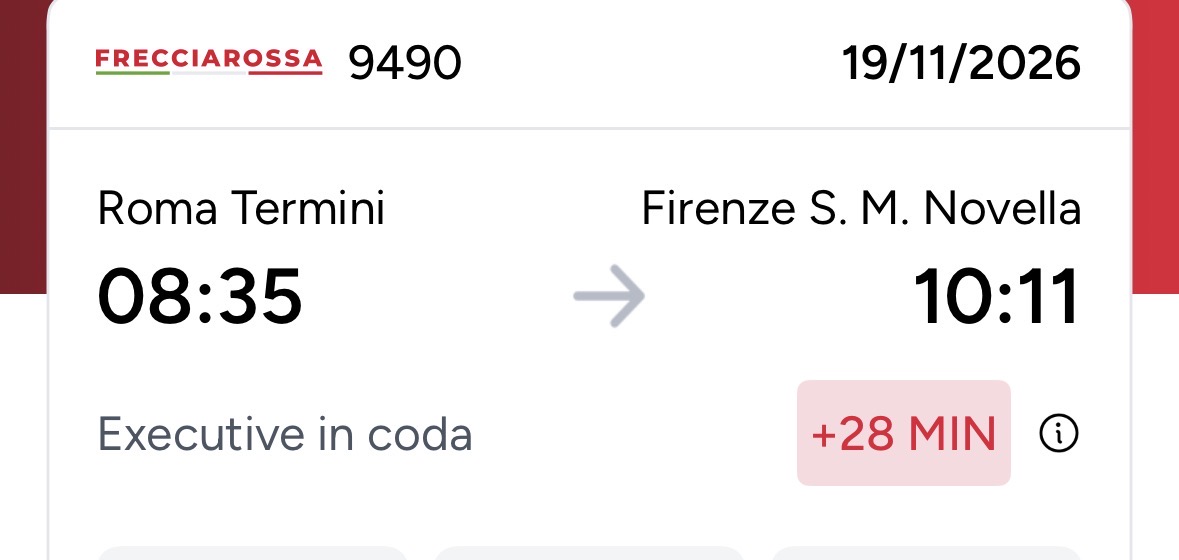
If you travel by train in Italy, you know the voice. Calm, polite, almost mechanical. It tells you that your train is running 25 minutes late, then 30, then 45. And every time, it apologises.
When I am not abroad, I spend a good part of my week on trains between Milan, Bologna, Florence and Rome. On paper, it is one of the best high-speed corridors in Europe. In practice, I have stopped asking whether my train will be late. The only question left is how late.
Every delay comes with an explanation. A strike. A fault on the line. A broken train ahead of us. Air conditioning that fails in July, heating that fails in November. Checks on the infrastructure. People on the tracks. A signalling failure. Copper theft. Bad weather, or simply “adverse weather conditions”. A train that left late from the previous station. “Operational reasons”, whatever that means. The reason changes. The apology stays the same.
We apologise for the inconvenience.
And then comes the question that bothers me the most: who pays?
Mostly, nobody. Well, compensation does exist. Trenitalia, for example, refunds 25% of the fare for delays between 60 and 119 minutes, and 50% beyond two hours. It is something. Getting it, though, means dealing with forms, deadlines and the small dark patterns that make you wonder whether it is worth asking at all. Not to mention that the time you spend chasing it has a price too.
That said, even in the best case, that small refund rarely comes close to what the delay actually cost. Because a delay is never just a delay. It is the meeting that starts without you. The client who waits, then stops waiting. The class you were supposed to open, with your students already wondering where you are. The conference where you were meant to speak first and end up speaking last, or not at all. The dinner you reach when everyone is already at dessert. The event you organised for months, with half the guests stuck somewhere between two stations.
We apologise for the inconvenience.
Meanwhile, those responsible for the tracks, the trains and the planning rarely seem to face any consequence. The delay happens, the apology is automatic, and tomorrow it happens again.
Oscar Wilde wrote a line that comes back to me every time I stare at a departure board. In “The Critic as Artist”, one of his characters says: “There is only one thing worse than Injustice, and that is Justice without her sword in her hand” .
That is exactly how a passenger feels. The rules exist. The rights exist. The sword does not. And an apology without consequences is just another way of saying the same thing.
The result is a quiet, constant frustration. We have learned to leave earlier, to build buffers into our days, to warn clients that “we might be a bit late, you know how trains are”. We have turned unpredictability into a routine. That might be the saddest part of all.
I love this country, and I know running a railway is hard. But I keep wondering whether this is what a civil country should feel like. Infrastructure is the floor everything else stands on: work, business, culture, even the simple idea that a promise printed on a timetable will be kept. When the floor keeps giving way, everything above it learns to move slowly and defensively.
It is hard to imagine a country evolving, innovating and attracting talent when getting from Milan to Florence on time has become a matter of luck.
Maybe the first step is to stop accepting the apology as if it were enough.
Next time the voice says “Ci scusiamo per il disagio”, I would like it to say something else, just once: “We fixed it.”