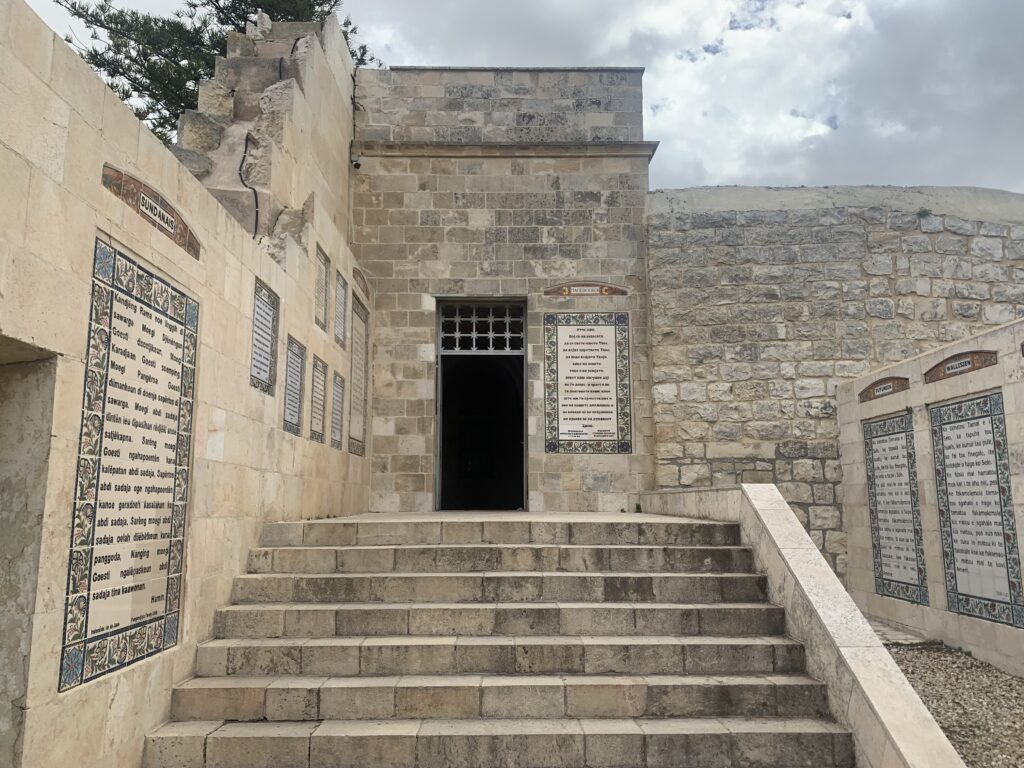
When I went to Jerusalem, I found myself, almost by accident, inside the Church of the Lord’s Prayer. It was not planned. I did not even know it existed. And, like many unplanned things, it left something behind.
I remember standing there, surrounded by dozens of translations of the same words. Familiar ones like Italian, English, Spanish, and others completely distant from my small world. Different alphabets, different sounds, different rhythms. And yet, the same prayer.
Jerusalem is full of places we call historical. Which already means something very concrete. It means that something truly happened there. Believing in the supernatural layer is a matter of faith, but the fact that something took place in that exact spot is often real. Then there are other places, less certain, less verifiable, suspended somewhere between tradition and narrative. The place of the Lord’s Prayer belongs, at least in part, to this second category. And yet, for that very reason, it feels even more powerful.
The Lord’s Prayer. In Italian, Padre Nostro. In Latin, Pater Noster. In English, Our Father. Even this shift tells a story. “Our Father” feels immediate, almost intimate. “Pater Noster” carries a different weight, something more vertical, more liturgical, less conversational. “Padre Nostro” sits somewhere in between, warmer, closer, almost domestic. Language does not simply translate. It positions us. It changes how we stand in front of the same words.
Jesus did not teach it immediately. He waited months before giving it to the apostles. Today we take it for granted. Most of the time we repeat it quickly, sometimes without even noticing it. But it was a gift. A profound one. And like all meaningful gifts, it required time, readiness, maybe even a kind of inner alignment.
This is why I consider it the most important prayer in Christianity. Because it was taught directly by Jesus. The Hail Mary is powerful, deeply rooted in Scripture, but part of it comes from tradition. The Lord’s Prayer does not have that layering. It arrives whole. Entirely given.
In the Middle Ages, people recited it relentlessly. One hundred, two hundred times a day. And the body was part of it. Hands joined, hands open upward, hands vertical. Each gesture carried meaning. Each posture expressed something words alone cannot fully contain. I have my preferences, of course, but today I am not sure there is a single right way. There are simply different ways of inhabiting the same words.
And those words matter. Every single one of them. They have been debated, interpreted, questioned for centuries. Even recently, things have shifted. “Lead us not into temptation” became “Do not let us fall into temptation.” “As we forgive” became “as we also forgive.” Small changes, almost invisible. But every word carries a world. And when we change the words, we reshape the world, even if only slightly.
This pattern of reshaping is not limited to the Lord’s Prayer. It runs through Scripture and liturgy alike.
In the Magnificat, Mary’s words shifted from “in me” to “for me.” Another subtle change, but not an innocent one. Because it moves the center from something happening within, from the mystery of the Immaculate Conception – a transformation that unfolds inside the person – to something happening for someone, almost like a gift delivered from the outside. It reverses the movement. And, in doing so, it quietly reshapes the way we understand grace.
In some modern translations of the Gospel, Matthew 17:21 simply disappeared. Quietly. No announcement, no explanation. And yet, its absence left a silence that to me feels heavier than words. If you read that verse, you realize it carries a weight that is not easy to handle. It speaks of a kind of evil that can only be cast out through prayer and fasting, as if naming a threshold that most of us would rather not acknowledge. Maybe that is exactly the point.
Go into the liturgical translation of the words of the Last Supper and you find another shift. The original Greek of Matthew 26:28 and Mark 14:24 says “περὶ πολλῶν”, “for many.” The Latin carries it faithfully: “pro multis”. But when the Roman Missal was translated into vernacular languages in the 1960s, “for many” became “for all” in several of them, including Italian. And that may change everything, because “for many” carries a tension, a limit, a possibility that not everyone will accept or receive the gift of salvation, while “for all” reassures. And in doing so, it quietly suggests that there may be no real risk, that in the end everyone is included anyway.
When I think about these shifts, I sometimes feel that we are trying to make God more understandable, more acceptable, more aligned with our sensitivity. A little closer to us. And slowly, almost without noticing, we end up shaping God in our image and likeness, instead of allowing ourselves to be shaped.
Maybe this is why I became almost obsessed with these nuances. And why I tend to return to Latin. To stay closer to something less filtered, less negotiated, less adjusted to us.
This morning, during a meditation that was not really a prayer, I found myself lingering on the last four words of the Lord’s Prayer. Just four words. And yet they felt like everything.
“Libera nos a malo”. Deliver us from evil.
This is, perhaps, the most uncomfortable and honest part of the prayer. Because it says something we often try to soften, reinterpret, or avoid.
Evil exists.
Not only as a metaphor. Not only as a psychological condition or a social construct. Evil is something real. Something that resists simplification. And the prayer names it.
Then it goes one step further, and tells us that we can be freed from it.
I try not to stand in front of these words from a single place. Jerusalem taught me that much. Looking at them with Daoist eyes, we could read them in terms of vibration, frequency, energy. Every word we speak shifts something within us. Words shape matter. They change our internal state and, through that, the way we experience reality. Prayer becomes a form of alignment, a way of tuning ourselves.
If we adopt a Christian perspective, we may go even deeper. Something happens not only because we change, but because there is a will beyond ours. Because there is a dimension that moves, even when we do not fully understand it.
If you believe in these four words, if you truly ask to be freed from evil, it will mean people will leave your life without a clear reason. Things you don’t want to happen will. Doors will remain closed. The request will turn into protection, and you likely won’t be able to see that what did not happen was, in the end, a form of grace.
It is hard to understand when it happens. Even harder to accept. And maybe the only real shift comes when the need to explain everything slowly begins to fade. 1 Corinthians 13 has always stayed with me for this reason, especially the part about seeing through a glass darkly, about knowing only in part, and trusting that one day we will know fully.
There was a time when I kept asking myself and destiny why things happened the way they did.
Then there was a time when I tried to build explanations, to give structure to what felt unclear.
At some point, I stopped.
Now I try to stay within what happens.
And maybe, one day, I will understand.